Loading...

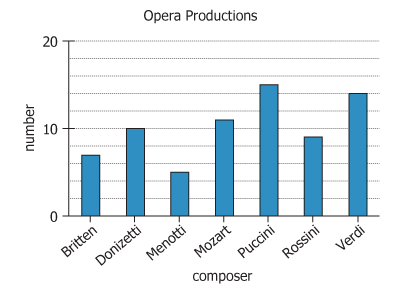
The graph shows the number of productions of operas composed by each of 7 composers that a certain opera company has presented in the last 40 years.
Select from each drop-down menu the option that creates the most accurate statement based on the information provided.
| Text Component | Literal Content | Interpretation |
|---|---|---|
| Subject | number of productions of operas | The dataset counts how many times operas were performed |
| Composers | composed by each of 7 composers | Data is broken down for each of 7 specific composers |
| Company | a certain opera company | Data comes from one specific (unnamed) opera company |
| Timeframe | in the last 40 years | Covers a 40-year span of performances |
| Composer | Number of Productions |
|---|---|
| Britten | 7 |
| Donizetti | 10 |
| Menotti | 5 |
| Mozart | 11 |
| Puccini | 15 |
| Rossini | 9 |
| Verdi | 14 |
Puccini, with 15 productions, has exactly \(50\%\) more productions than Donizetti, who has 10; this is the only composer pair in the dataset with this precise '\(50\%\) more' relationship. The number of productions for other composers ranges from 5 to 14. The data covers a 40-year history from a single opera company and allows analysis of production frequency and proportional relationships.
In the last 40 years, the opera company presented exactly \(50\%\) more productions of operas composed by [BLANK 1] than by [BLANK 2].
In the last 40 years, the opera company presented exactly \(50\%\) more productions of operas composed by Puccini than by [BLANK 2].
By examining the production counts for each composer, we determined Puccini (15 productions) is exactly \(50\%\) more than Donizetti (10 productions), and this is the only matching pair in the lists.
The blanks are dependent; knowing one answer immediately determines the other due to the unique numerical relationship.