Loading...

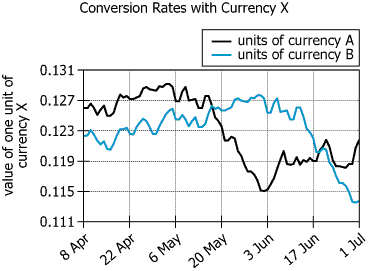
The graph shows the history of the value of currency X—in units of currency A and in units of currency B—for the 12-week period beginning on 8 April.
Based on the information provided, select from each drop-down menu the option that creates the most accurate statement.
| Text Component | Content |
|---|---|
| Subject | The value of currency X over time |
| Reference Currencies | Measured in units of currency A and currency B |
| Time Span | 12-week period, beginning on 8 April |
| Data Description | Historical exchange rates of X to A and X to B |
| Chart Feature | Description |
|---|---|
| Chart Type | Two-line chart (one for \(\mathrm{X/A}\), one for \(\mathrm{X/B}\)) |
| X-Axis | Dates: 12 weeks starting 8 April |
| Y-Axis | Value of currency X (from \(\mathrm{0.111}\) to \(\mathrm{0.131}\)) |
| Series 1 (black) | Value of X in terms of currency A |
| Series 2 (blue) | Value of X in terms of currency B |
| Peak Points | Each line reaches its own maximum at different weeks |
| Crossing Point | Lines cross around early June, indicating changing relative value |
For the 12-week period shown in the graph, the greatest value of a unit of currency X expressed in units of currency A occurred around ______.
What is needed: The date when the black line (\(\mathrm{X/A}\)) reaches its highest point.
...and the greatest value of a unit of currency X expressed in units of currency B occurred around ______.
What is needed: The date when the blue (cyan) line (\(\mathrm{X/B}\)) reaches its highest point.
By matching each colored line to its currency and analyzing their peaks in relation to the crossover in early June, we find the greatest value for X in A occurs around 04 May and for X in B around 01 June.
Each blank refers to the value of currency X in a different reference currency; the answers are found independently by analyzing separate lines on the chart.