Loading...

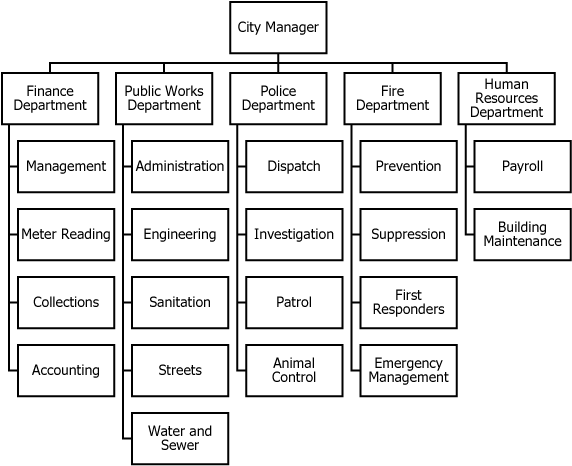
The chart depicts the organizational structure of the government of City C. Currently, 5 departments report directly to the City Manager, and each department consists of 2–5 agencies. Due to budgetary concerns, the government will be restructured as follows. The Human Resources Department and its agencies will be eliminated. Payroll will be moved to the Finance Department where it will be part of a single agency created by consolidating Accounting and Collections; Building Maintenance responsibilities will be transferred to Engineering. The Police and Fire Departments will be consolidated into a single department, and Prevention and Suppression will be merged into a single agency of that consolidated department.
From the drop-down menus, select the options that create the most accurate statement based on the information provided.
| Text Component | Literal Content | Simple Interpretation |
|---|---|---|
| Current Structure | "5 departments report directly to the City Manager" | There are currently 5 departments under the City Manager |
| Department Size | "each department consists of 2–5 agencies" | Each department is subdivided into 2 to 5 agencies |
| Reason for Change | "Due to budgetary concerns, the government will be restructured as follows." | Budget issues are driving organizational changes |
| HR Eliminated | "The Human Resources Department and its agencies will be eliminated." | HR and its agencies will no longer exist |
| Payroll Movement | "Payroll will be moved to the Finance Department where it will be part of a single agency created by consolidating Accounting and Collections" | Payroll merges into Finance with Accounting and Collections as one agency |
| Building Maintenance Transfer | "Building Maintenance responsibilities will be transferred to Engineering." | Building Maintenance moves to Public Works/Engineering |
| Police & Fire Consolidation | "Police and Fire Departments will be consolidated into a single department" | Police and Fire become one department |
| Prevention & Suppression Merge | "Prevention and Suppression will be merged into a single agency of that consolidated department" | Two agencies become one in the new department |
| Chart Component | Observed Structure | Implication |
|---|---|---|
| Hierarchy | 3 levels: City Manager > Departments > Agencies | Standard organizational chain of command |
| Departments | 5: Finance, Public Works, Police, Fire, Human Resources | Matches text description |
| Agencies per Department | Finance: 4, Public Works: 5, Police: 4, Fire: 4, HR: 2 | Distribution shows HR is the smallest, Public Works is the largest |
| Agency Names | Labeled per department; e.g. Finance: Management, Meter Reading, Collections, Accounting | Clear breakdown for restructuring impact |
| Structure after Restructuring | Fewer departments, agencies consolidated | Anticipate more consolidation/mergers post-change |
After restructuring, department count drops from 5 to 3: Finance (expands with Payroll/merged agency), Public Works (gains Building Maintenance in Engineering), and a consolidated Public Safety department (merger of Police and Fire, with Prevention/Suppression also merged). Agency distribution per department will become more uneven, reflecting administrative streamlining and new reporting structures due to budget constraints.
As a result of the restructuring, a total of _____ departments will report to the City Manager
The maximum number of agencies per department will be _____
After the restructuring, the city will have 3 departments reporting to the City Manager. By merging Police and Fire, their combined department will have the most agencies—7 in total.
Both questions can be answered independently. The number of departments (blank 1) depends on eliminations and consolidations, while the maximum number of agencies (blank 2) depends on the new department structures after these changes. No information from one calculation is required for the other.