Loading...

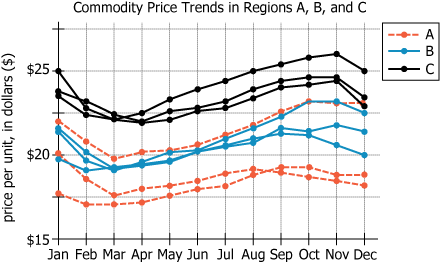
Over the last three years, a certain commodity was regularly sold in Regions A, B, and C. For each of the three regions, the graph shows the trend within each year of the monthly average price per unit of the commodity.
Based on the information provided, select from each drop-down menu the option that creates the most accurate statement.
| Text Component | Content | Interpretation |
|---|---|---|
| Time period | Over the last three years | 3-year data window |
| Commodity | a certain commodity | Specific product not named |
| Regions | regularly sold in Regions A, B, and C | Prices tracked separately for three regions |
| Trend description | the graph shows the trend within each year | Emphasis on annual seasonal patterns |
| Measurement | monthly average price per unit | Monthly prices reflect market trends for the commodity |
| Chart Element | Details | Implication |
|---|---|---|
| Chart type | Multi-series line chart (6 lines total) | Compares seasonal price trends among regions |
| X-axis | Months Jan-Dec | Shows variation and peaks during the year |
| Y-axis | Price per unit ($15 to $25+) | Allows price comparison between regions and over time |
| Region A lines | 2 colored lines, lower range ($17-$19) | Region A has consistently lower prices |
| Region B lines | 2 colored lines, mid range ($19-$23) | Region B prices are intermediate |
| Region C lines | 2 colored lines, peaking above $25 in Oct-Nov | Region C reaches highest prices, especially late in year |
| Seasonal pattern | All regions trend upward toward Oct-Nov | Price peaks are seasonal, largest differences in late year |
Region C achieves the highest prices for the commodity, particularly in October and November when values exceed $25 per unit—these are the best times and places to sell. There is a clear seasonal pattern: prices in all regions rise through the year, peaking in Oct-Nov, and then drop in December. Throughout the year, Region C's prices remain above those of Regions B and A, which follow in descending order.
On the assumption that the trends in the graph would continue, someone seeking to sell this commodity at the highest possible price would likely try to sell the commodity in Region [BLANK 1]
someone seeking to sell this commodity at the highest possible price would likely try to sell the commodity in Region C, in either [BLANK 2]
The highest prices for selling this commodity are consistently found in Region C, especially during the months of October or November. The decision is based on observing three years of data where Region C outperforms the other regions and shows clear seasonal peaks in the late fall.
These two blanks are dependent. Identifying the region with the highest price (Region C) directly leads to finding the best time to sell within that region (October or November). The timing only matters once the region is established.