Loading...

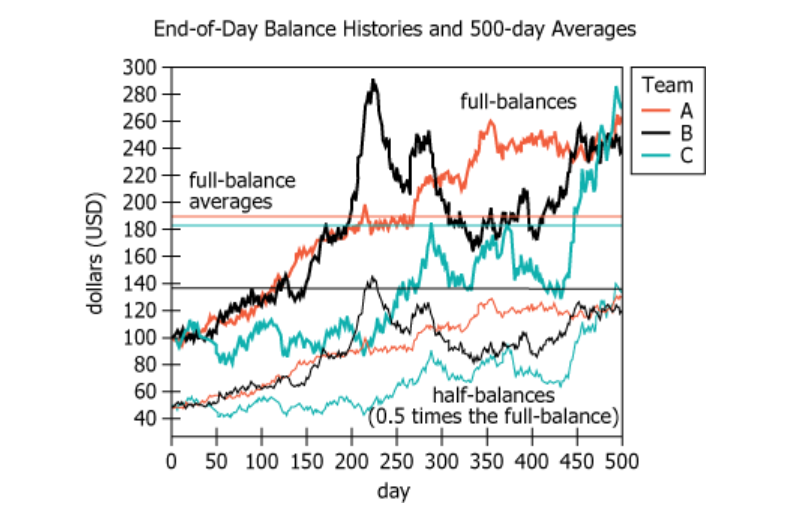
In a 500-day simulated currency-trading contest, three teams-Teams A, B, and C-applied automated currency-trading algorithms as the exchange rate data were streamed to their computers in real time. At the end of each day, each team's simulated balance (full-balance), in USD, was recorded. The contest was decided on the basis of these full-balances and their associated half-balances (0.5 times the corresponding full-balance). At the end of Day 500, the teams reported their full-balance and half-balance histories as well as their 500-day average full-balance. This information is shown in the graph. The winner of the contest was to be the team that earned the greatest number of the following points: 1 point for having at least one half-balance that exceeded another team's same-day full-balance on at least one day; 1 point for having the greatest 500-day full-balance average; and 1 point for having the greatest full-balance at the end of at least 80% of the days. In the event of a tie, the team with the greatest 500-day full-balance average was to be declared the winner.
Select from each drop-down menu the option that creates the most accurate statement.| Text Component | Literal Content | Simple Interpretation |
|---|---|---|
| Contest Duration | "500-day simulated currency-trading contest" | The contest lasted 500 days |
| Teams | "three teams-Teams A, B, and C" | Three teams (A, B, C) participated |
| Trading Method | "applied automated currency-trading algorithms as the exchange rate data were streamed to their computers in real time" | Teams used automated programs to trade using live currency data |
| Balances Recorded | "At the end of each day, each team's simulated balance (full-balance), in United States dollars (USD), was recorded, along with the half-balance (0.5 times the corresponding full-balance)" | Daily tracking of each team's full- and half-balances in USD |
| Scoring Point 1 | "1 point for having at least one half-balance that exceeded another team's same-day full-balance on at least one day" | A team scores 1 point if their half-balance beats another's full-balance even once |
| Scoring Point 2 | "1 point for having the greatest 500-day full-balance average" | A team with the highest average full-balance over 500 days gets 1 point |
| Scoring Point 3 | "1 point for having the greatest full-balance at the end of at least 80% of the days (at least 400 of the days)" | Team with the most daily wins (\(\geq 400\) days) gets 1 point |
| Tiebreaker | "In the event of a tie, the team with the greatest 500-day full-balance average was to be declared the winner." | If points are tied, the team with the highest average wins |
| Chart Element | Description | Interpretation |
|---|---|---|
| Line Chart | 6 lines: 3 teams (A,B,C) × (full-balance, half-balance) | Tracks balances of each team daily for 500 days |
| X-axis | Days 0–500 | Contest spans 500 days |
| Y-axis | USD range 0–300 | All balances remain below $300 |
| Reference Lines | 3 horizontal: team full-balance averages ($180–$190) | Indicates long-term performance; B highest, A middle, C lowest average |
| Team A (black) | Highly volatile, peaking near $290 on day ~250 | Large swings, high risk/high reward strategy |
| Team B (red/orange) | Steady, gradual growth from $100 to $260 | Most consistent and stable gain |
| Team C (cyan) | Initial sharp drop to $60, strong recovery to nearly $280 | Poor start, strong finish |
| Half-balance crossovers | Several thin (half-balance) lines cross above thick (other teams' full-balance) lines | Each team likely achieved the 'half-balance exceeds another's full-balance' condition |
Team B demonstrated the highest consistency and achieved the top 500-day average balance, suggesting it earned at least one scoring point and holds the tiebreaker. Team B also appears to have led in balance for the majority (>80%) of days. Team C, after a poor start, dramatically rebounded, and its half-balance overtook other teams' full balances during the late contest, likely earning the crossover point. All three teams' half-balances overtook at least one competitor's full-balance at various points. Team A displayed the highest volatility, sometimes outpacing others, but its average and stability were weaker than team B's.
In the contest, Team [BLANK 1] was declared the winner
after winning [BLANK 2] points
Team A is the winner of the contest, earning 2 points: one for achieving the highest 500-day average and one for having its half-balance cross another team's full-balance at some point. Team A did not lead for 80% of the contest days, so it did not earn a third point.
The questions are dependent. The second blank requires knowing which team won (from the first blank) to determine how many points that winning team earned.