Loading...

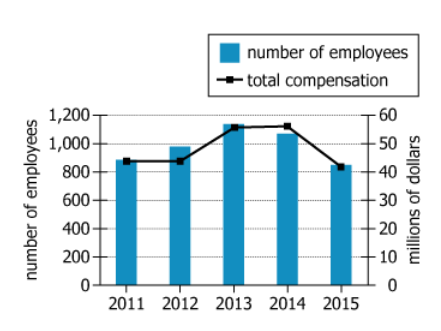
For each year from 2011 through 2015, the graph shows the number of employees of a certain company during that year, together with the total amount paid by the company in compensation to its employees during that year.
Select from each drop-down menu the option that completes the statement so that it has the most support from the information provided.
| Text Component | Literal Content | Simple Interpretation |
|---|---|---|
| Time Period | For each year from 2011 through 2015 | Data covers five years: 2011, 2012, 2013, 2014, 2015 |
| Subject | a certain company | The data concerns one specific (unnamed) company |
| Metrics Provided | number of employees... total amount paid by the company in compensation to its employees | Data includes annual employee count and total employee compensation |
| Granularity | during that year | All data is annual, with one set of figures per year |
| Chart Component | What's Shown | Interpretation |
|---|---|---|
| X-axis (Years) | 2011, 2012, 2013, 2014, 2015 | Each data column/point reflects that year |
| Blue Bars | Number of employees, scale 0-1,200 (left Y-axis) | Number of employees ranges from 830 to 1,140 |
| Black Line | Total compensation in millions, scale 0-60 (right Y-axis) | Total compensation ranges from \(\$42\mathrm{M}\) to \(\$56\mathrm{M}\) |
| Employee Trend | Increases 2011-2013, peaks in 2013 (1,140), decreases 2014-2015 | Company staff grew, peaked, then reduced |
| Compensation Trend | Flat 2011-2012 (\(\$43\mathrm{M}\)), rises 2013-2014 (\(\$55\mathrm{M}\)-\(\$56\mathrm{M}\)), drops in 2015 (\(\$42\mathrm{M}\)) | Payout not always proportional to employee count |
| Compensation/Employee | Average compensation shifts—highest in 2014, lowest in 2012 | Varying average pay per employee year-to-year |
The year in which the average (arithmetic mean) annual compensation per employee was GREATEST was ______
The year in which the average (arithmetic mean) annual compensation per employee was LEAST was ______
To solve both blanks, we used estimation to find the average annual compensation per employee for each year. 2014 had the highest average (\(\sim\$53\mathrm{k}\)), and 2012 had the lowest (\(\sim\$44\mathrm{k}\)). Recognizing how the ratio shifts with both numerator (total compensation) and denominator (number of employees) was key to answering efficiently.
The two blanks are independent. Both ask for extreme values (maximum for Blank 1, minimum for Blank 2) for the same derived metric, but finding one does not directly give the other. Each must be checked individually.