Loading...

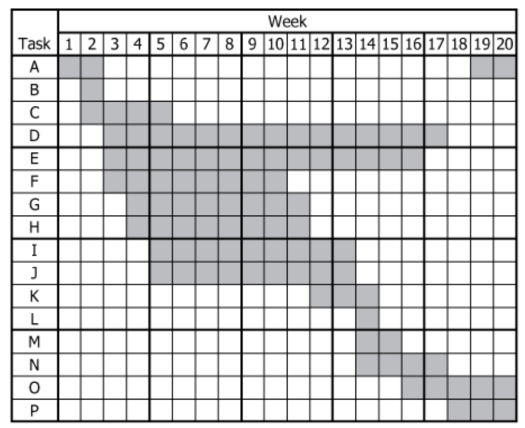
For each task of a 20-week project, the chart shows the time interval, in weeks, of that task. For example, Task K starts at the beginning of Week 12 and is completed at the end of Week 14.
Based on the information provided, select from each drop-down menu the option that creates the most accurate statement.
| Text Component | Literal Content | Simple Interpretation |
|---|---|---|
| Project Duration | "20-week project" | The project lasts 20 weeks total. |
| Chart Purpose | "the chart shows the time interval, in weeks, of that task" | The chart displays which weeks each task is active. |
| Usage Example | "Task K starts at the beginning of Week 12 and is completed at the end of Week 14" | Tasks run from the start of one week to the end of the final week listed. |
| Chart Element | Description | Interpretation |
|---|---|---|
| Chart Type | Horizontal bar (Gantt-style) chart | Shows tasks over time; tasks as bars spanning weeks |
| X-axis | Labeled Weeks 1 to 20 | Each position represents a week in the project |
| Y-axis | Tasks labeled A through P (16 total) | Each bar is a different task; all tasks visible |
| Bar Overlaps | Multiple bars occupy the same weeks (e.g. A/B, D/E, O/P overlap) | Multiple tasks can occur at the same time |
| Gaps in Bars | Some weeks have no bar for certain rows (e.g., gap between J and K) | Not every week has maximum concurrency |
The dataset (text plus chart) illustrates a project schedule across 20 weeks and 16 tasks. Multiple tasks are often scheduled in parallel, as seen by overlapping bars for several tasks during the same weeks. There are periods of high concurrency (several bars stacked vertically for the same week), especially in the early and middle weeks, indicating peak workload. Some weeks have fewer or no concurrent tasks, such as gaps around the middle of the schedule. Determining the week with the highest number of simultaneous tasks requires counting the overlaps in each week, with the busiest periods likely between weeks 3-7.
The greatest number of activities taking place simultaneously during the project is ______.
What is needed: The maximum number of project tasks that are active during the same week.
The greatest number of activities taking place simultaneously during the project is 8, in Week ______.
What is needed: The week number where the most simultaneous activities take place.
By tallying the number of active project tasks each week, we find that the maximum simultaneous activities is 8, occurring in Week 5 where all tasks A through H overlap.
The two blanks are dependent: to find the week for blank 2, one must have already identified the number from blank 1. Blank 2's answer depends on the solution to blank 1.