Loading...

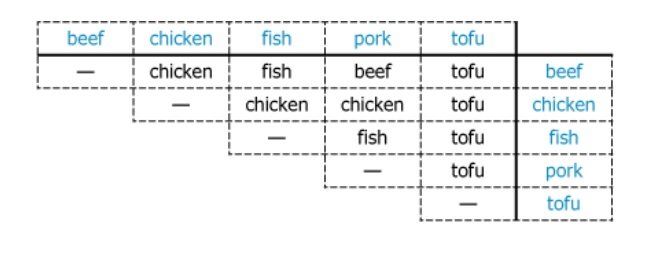
A restaurant asked a focus group to rate 5 new dishes, each of which features either beef, chicken, fish, pork, or tofu. The focus group was asked to make a comparison of each pair of dishes and to choose which of the two dishes they preferred. The graphic shows the focus group's preferences. For example, when the focus group compared the dish featuring beef to the dish featuring chicken, their preference was the dish featuring chicken, and this is indicated at the intersection of the horizontal row containing the label beef on the far right and the vertical column containing the label chicken at the top.
From each drop-down menu, select the option that creates the most accurate statement based on the information provided.
| Text Component | Literal Content | Simple Interpretation |
|---|---|---|
| Study setup | A restaurant asked a focus group to rate 5 new dishes, each of which features either beef, chicken, fish, pork, or tofu | A restaurant tested 5 dishes, each with a different main protein, using a focus group |
| Methodology | The focus group was asked to make a comparison of each pair of dishes and to choose which of the two dishes they preferred | People compared each possible pair and picked their favorite of the two |
| Data representation | The graphic shows the focus group's preferences | The chart summarizes which dish was preferred in every head-to-head comparison |
| Reading instructions | For example, when the focus group compared the dish featuring beef to the dish featuring chicken, their preference was the dish featuring chicken [...] | The winner for each pair is found at the intersection of row (first dish) and column (second dish) |
| Chart Feature | Description | Interpretation |
|---|---|---|
| Chart type | Matrix/grid with dishes as both rows and columns | Displays all head-to-head preferences between dish pairs |
| Matrix entries | Each cell (not on diagonal) contains the preferred dish in each pairwise comparison | Shows which dish was preferred in each specific matchup |
| Reading approach | Find intersection of row (right label) and column (top label) to see preferred dish | Reveals outcome for a chosen pair |
| Preference pattern | Winners distributed among different proteins; no dish wins consistently across all pairings | Preferences are varied; no universally preferred dish |
Each row-column intersection in the matrix shows which of two dishes was preferred, providing a full set of pairwise preference data. However, there are some missing or inconsistent entries (e.g., no comparison between chicken and pork, and an error in the fish vs pork cell), so the dataset is slightly incomplete. Overall, no single dish dominated all others; preferences were distributed among the offerings, showing varied tastes among participants.
The focus group preferred the dish featuring [BLANK] to every other dish.
The focus group preferred every other dish to the dish featuring [BLANK].
By analyzing the chart and counting the number of wins for each dish, Tofu is the only dish to have 4 wins—making it the most preferred. Pork, with only 1 win and 4 losses, is least preferred. The questions require counting wins and losses for each dish in the preference matrix.
The blanks are independent: one asks which dish wins against all others, the other which dish loses to all others. Answering one does not give away the answer to the other.